

Optical Filter Coating Explained: How Thin Films Control Light in Camera Systems
Modern smartphone cameras are small, but their optical requirements are anything but simple.
A phone camera needs to capture accurate colors, preserve detail, manage strong and weak light, and produce clean images through a very compact optical system. Behind these capabilities are carefully engineered lenses, sensors, filters, and thin-film coatings.
One important part of this optical architecture is optical filter coating.
Unlike a general protective coating, an optical filter coating is designed primarily to control how different wavelengths of light interact with a surface. It can selectively transmit desired wavelengths while reducing unwanted portions of the spectrum.
This function is particularly important in digital cameras, where the image sensor responds to a broad range of light and may require spectral control to reproduce images correctly.
For smartphone camera components, coating design therefore involves much more than simply making a surface transparent. The coating needs to provide predictable spectral performance, low optical loss, strong adhesion, and reliable performance through manufacturing and product use.
What Is Optical Filter Coating?
An optical filter coating is a thin-film coating designed to selectively control light transmission and reflection across specific wavelength ranges.
Depending on the design, the coating can function as a:
- Infrared blocking filter
- Ultraviolet blocking filter
- Bandpass filter
- Long-pass filter
- Short-pass filter
- Spectral transmission filter
- Reflective optical filter
The coating’s behavior is determined by its materials, layer structure, thickness, and refractive-index characteristics.
Unlike a simple transparent protective layer, an optical filter coating is intentionally engineered to have a specific spectral response.
Why Optical Filters Matter in Camera Systems
A camera sensor doesn’t simply detect the visible light that humans see.
Many image sensors can respond to wavelengths outside the visible range, particularly in the near-infrared region.
If unwanted wavelengths reach the sensor, they can affect image color and overall image quality.
An optical filter can help control this response.
Controlling the Light Spectrum
The goal is to ensure that the camera receives the wavelengths required for the intended imaging function.
For a conventional RGB smartphone camera, this may mean allowing visible wavelengths through while suppressing unwanted infrared radiation.
For specialized cameras, the requirements can be different.
The coating therefore needs to be designed according to the sensor and optical system rather than selected as a generic transparent film.
Protecting Image Quality
Spectral control can influence several aspects of image performance.
A properly designed optical filter can help support:
- Accurate color reproduction
- Consistent white balance
- Improved contrast
- Reduced unwanted spectral response
- More predictable sensor performance
The coating is one component within a larger imaging system, so its design needs to be coordinated with the sensor and lens assembly.
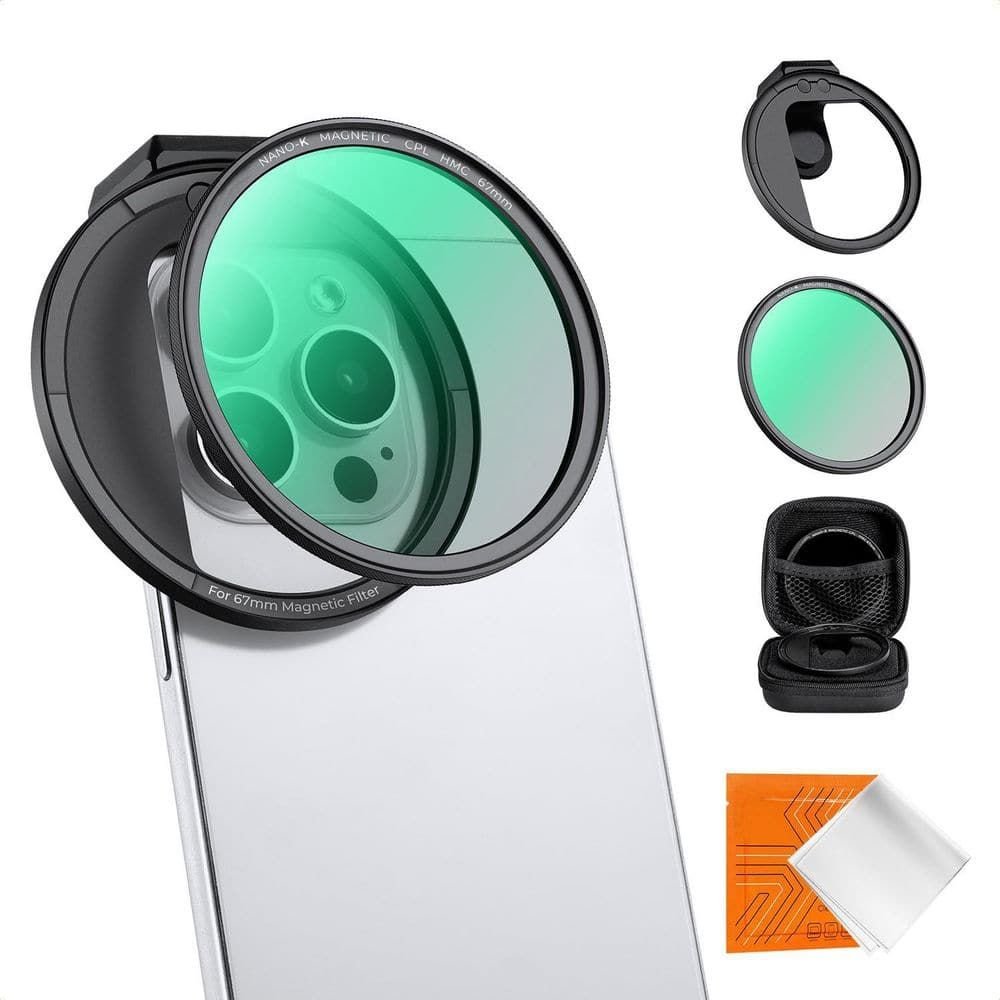
How Optical Filter Coating Works
Many optical filter coatings use thin-film interference.
When light encounters a multilayer coating, reflections from different interfaces interact with one another.
By controlling the thickness and refractive index of individual layers, engineers can create constructive or destructive interference at selected wavelengths.
This makes it possible to control the transmission and reflection spectrum.
Thin-Film Interference
Thin-film interference is fundamental to many precision optical coatings.
The thickness of each film is carefully controlled because even small changes can shift the resulting spectral response.
For applications with demanding wavelength requirements, coating thickness uniformity becomes especially important.
Multilayer Optical Structures
A multilayer coating may contain many alternating layers.
The layer sequence is designed to create the desired spectral curve.
This can provide more precise control than a simple single-layer structure.
Multilayer designs can be optimized for:
- Visible transmission
- Infrared rejection
- UV rejection
- Narrow wavelength bands
- Broad wavelength ranges
The exact architecture depends on the application.
Key Functions of Optical Filter Coating
The main advantage of a filter coating is selective optical control.
IR Blocking
Infrared blocking is particularly relevant to conventional digital camera systems.
Image sensors can respond to near-infrared wavelengths, but these wavelengths can interfere with normal color imaging.
An IR-blocking coating can reduce unwanted infrared transmission while maintaining the desired visible-light response.
This helps the camera system produce more predictable color information.
UV Blocking
Ultraviolet radiation can also be controlled when required.
UV-blocking functionality can protect sensitive optical components and limit unwanted spectral response.
The required UV cutoff depends on the application.
Spectral Transmission Control
Not every optical filter needs to simply block infrared or ultraviolet light.
Some systems require a carefully shaped transmission curve.
For example, a coating may need to provide high transmission across a selected visible range while sharply reducing transmission outside that range.
This is where precision thin-film design becomes important.
Optical Filter Coating for Smartphone Cameras
Smartphone camera modules provide a particularly demanding environment for optical coatings.
The optical components are extremely compact, while image quality expectations are very high.
The coating may be integrated into or applied to components such as:
- Camera cover windows
- Optical filter elements
- Lens-related optical components
- Sensor protection components
The coating must deliver predictable optical performance while remaining compatible with high-volume manufacturing.
Camera Lens and Cover Components
A smartphone camera contains several optical interfaces.
Each surface can influence reflection and transmission.
An optical filter coating can be used to control specific wavelength regions, while other coating functions can be used to reduce reflection or improve surface durability.
This means a camera module may use several coating technologies together.
For smartphone camera applications, SRNC’s Functional Coating for Cell Phone Camera page provides a relevant overview of surface-functional coating solutions designed for camera components.
Image Color and Contrast
Spectral filtering can influence how the sensor receives light.
When unwanted wavelengths are controlled correctly, the imaging system can work closer to its intended spectral response.
This can contribute to more accurate color reproduction and consistent image processing.
However, image quality is determined by the complete camera system, including the sensor, lens, filter, image-processing algorithms, and lighting environment.
Optical Performance Requirements
An optical filter coating must be designed around measurable optical targets.
Transmission
Transmission describes how much light passes through the coated component.
High transmission is generally desirable within the intended passband.
For a visible-light camera filter, excessive transmission loss in the desired range can reduce the amount of useful light reaching the sensor.
Reflection
Reflection needs to be controlled because unwanted reflected light can reduce optical efficiency and contribute to flare or ghost effects.
Filter designs may therefore incorporate anti-reflective characteristics where appropriate.
Spectral Accuracy
The shape of the transmission curve is often more important than simply achieving high overall transmission.
Key parameters can include:
- Cutoff wavelength
- Passband
- Stopband
- Blocking range
- Transition steepness
- Average transmission
These parameters should be specified according to the sensor and application.
Optical Filter Coating and Camera Image Quality
A filter coating doesn’t directly “create” image quality.
Instead, it helps establish the optical conditions under which the sensor operates.
For example, uncontrolled infrared transmission can cause color shifts, while excessive surface reflection can contribute to flare.
By controlling these optical effects, coating technology can support the overall performance of the camera module.
This is why optical coatings should be evaluated at the system level.
Coating Materials and Deposition
Optical filter coatings can use carefully selected dielectric materials with different refractive indices.
The materials are arranged into controlled thin-film structures.
Common deposition approaches for precision optical films include vacuum-based processes.
The selected process should provide:
- Accurate film thickness
- Good uniformity
- Strong adhesion
- Low defect levels
- Repeatable optical performance
For high-volume smartphone components, repeatability is especially important.
Durability and Environmental Stability
Optical performance isn’t enough if the coating cannot survive the product’s environment.
A camera component may encounter:
- Temperature changes
- Humidity
- Cleaning
- Mechanical handling
- Assembly stress
- Long-term aging
The coating should remain stable under the conditions expected during manufacturing, transportation, and use.
Adhesion is particularly important.
A coating that changes optical behavior or delaminates during environmental testing cannot provide reliable long-term performance.
Optical Filter Coating Manufacturing Process
A typical manufacturing flow can include several stages.
1. Substrate Preparation
The optical substrate is cleaned and inspected.
2. Surface Conditioning
Additional preparation may be performed to support adhesion and coating quality.
3. Thin-Film Deposition
The selected materials are deposited under controlled conditions.
4. Layer Thickness Control
For multilayer coatings, each film layer must be deposited to its specified thickness.
5. Optical Measurement
Transmission and reflection spectra are measured.
6. Environmental and Mechanical Testing
The coating is evaluated for adhesion and durability.
7. Final Inspection
The finished component is checked against the required optical specifications.
Quality Control for Optical Filter Coating
Quality control should focus on both the optical spectrum and physical coating condition.
Important measurements may include:
| Parameter | Purpose |
|---|---|
| Spectral transmission | Confirms passband performance |
| Spectral reflection | Evaluates reflection behavior |
| Cutoff wavelength | Confirms filtering point |
| Film thickness | Controls spectral response |
| Uniformity | Maintains consistent performance |
| Adhesion | Prevents delamination |
| Haze | Protects image clarity |
| Environmental stability | Confirms long-term performance |
For camera components, coating defects can be particularly important because even small particles or non-uniform areas may become visible in the final image.
Optical Filter Coating vs. Anti-Reflective Coating
These two coating types are related but have different primary purposes.
| Coating | Main Function |
|---|---|
| Optical filter coating | Selectively controls wavelengths |
| Anti-reflective coating | Reduces surface reflection |
| Hard coating | Improves surface durability |
| Protective coating | Protects against mechanical/environmental damage |
In a sophisticated camera module, more than one function may be required.
A component may therefore use a multilayer structure that combines spectral filtering with reflection control.
How to Select an Optical Filter Coating
The selection process should start with the optical system rather than the coating material.
1. Define the Wavelength Range
Identify the wavelengths that need to pass through the component and those that need to be blocked.
2. Define the Sensor Response
The filter should be designed around the spectral sensitivity of the image sensor.
3. Set Transmission Targets
Determine the required transmission within the passband.
4. Set Blocking Requirements
Define the required rejection level outside the desired spectral range.
5. Consider Angle of Incidence
Thin-film filters can change spectral behavior with incident angle.
The expected optical geometry therefore matters.
6. Consider Environmental Conditions
Temperature, humidity, and mechanical handling can influence coating durability.
7. Validate the Complete Component
Final testing should be performed on the actual coated optical component.
Optical Filter Coating for Other Optical Applications
Although smartphone cameras are a major application, optical filter coatings are used in many other systems.
Potential applications include:
- Machine vision
- Security cameras
- Automotive cameras
- Medical imaging
- Industrial sensors
- Scientific instruments
- Laser systems
- Consumer optical devices
Each application can require a different spectral response.
A filter designed for a visible-light camera isn’t automatically suitable for an infrared sensor.
Future Development of Optical Filter Coatings
Camera systems continue to become smaller while demanding higher optical performance.
This creates pressure for thinner and more precisely controlled optical films.
Future coating development is likely to focus on:
- More accurate spectral control
- Higher transmission
- Lower reflection
- Better environmental stability
- Smaller optical components
- More complex multilayer structures
- Higher production consistency
As camera modules become increasingly sophisticated, coating technology becomes an important part of optical system engineering rather than a secondary surface treatment.
Frequently Asked Questions
What is optical filter coating?
Optical filter coating is a thin-film coating designed to selectively transmit or reflect specific wavelengths of light.
What is optical filter coating used for in cameras?
It can control unwanted wavelengths, such as infrared or ultraviolet light, and help the camera sensor receive the intended spectral range.
What is an IR cut coating?
An IR cut coating is designed to reduce infrared transmission while allowing the required visible wavelengths to pass through.
Can optical filter coating improve camera color accuracy?
It can support accurate color reproduction by controlling the wavelengths reaching the image sensor. Final color performance also depends on the sensor, lens, image processing, and lighting.
What materials are used for optical filter coatings?
Precision optical filters commonly use dielectric thin-film materials with carefully selected refractive indices. The exact materials depend on the required spectral response.
Why are multilayer coatings used for optical filters?
Multiple layers provide greater control over transmission and reflection, allowing engineers to create more precise spectral characteristics.
Does optical filter coating reduce reflection?
A filter coating can be designed to manage reflection, but its primary purpose is wavelength selection. Dedicated anti-reflective structures may be incorporated when lower reflection is required.
Can optical filter coatings be used on camera cover glass?
Yes. Depending on the component design, optical filter functionality can be integrated with camera-related glass or other transparent optical components.
How is optical filter coating tested?
Testing typically includes spectral transmission, reflection, cutoff wavelength, uniformity, adhesion, environmental stability, and other application-specific measurements.
Conclusion
Optical systems depend on precise control of light.
For smartphone cameras and other imaging devices, unwanted wavelengths can affect the way the image sensor responds to the scene. Optical filter coating provides a practical way to control this spectral response through carefully engineered thin-film structures.
By selecting appropriate materials, layer thicknesses, and coating architectures, manufacturers can create surfaces that transmit desired wavelengths while suppressing unwanted radiation.
The technology can be particularly valuable in compact camera modules, where optical performance, component size, manufacturing consistency, and durability all have to work together.
For manufacturers exploring functional surface solutions for smartphone camera components, the Functional Coating for Cell Phone Camera page provides a relevant starting point.
The key to a successful optical filter isn’t simply maximum transmission or maximum blocking. It’s achieving the right spectral response, optical efficiency, uniformity, adhesion, and long-term stability for the complete imaging system.