

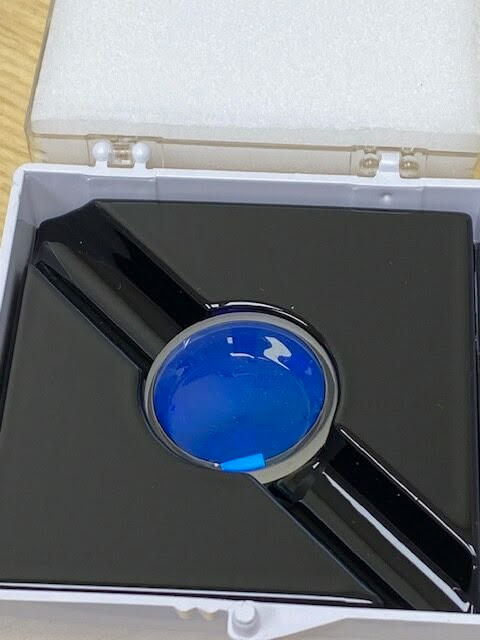
Optical Coating Technology: How Precision Thin Films Control Light and Protect Surfaces
Light can behave very differently when it reaches a coated surface. A transparent component may reflect part of the incoming light, transmit another portion, and absorb a small amount depending on the material and surface structure.
For many optical systems, these effects need to be carefully controlled.
This is the purpose of optical coating technology.
Optical coatings use carefully engineered thin films to change how a surface interacts with light. By selecting suitable materials and controlling film thickness, refractive index, and layer structure, manufacturers can design surfaces for anti-reflection, high reflection, spectral filtering, UV protection, IR control, or other optical functions.
The technology is especially important for precision components made from sapphire, glass, fused silica, and other optical materials.
But optical performance isn’t the only consideration. Many optical components are exposed to mechanical handling and environmental conditions. A well-designed coating system may therefore combine optical functionality with surface protection.
What Is Optical Coating Technology?
Optical coating technology is the engineering of thin-film layers on optical surfaces to control light transmission, reflection, or absorption.
The basic principle relies on the interaction of light with thin layers of material.
By controlling the thickness and optical properties of each layer, manufacturers can influence the way reflected and transmitted light behaves.
Common optical coating functions include:
- Anti-reflection
- High reflection
- Partial reflection
- Optical filtering
- UV control
- IR control
- Beam splitting
- Surface protection
A coating may consist of one layer or many layers.
For demanding applications, multilayer structures are often used because they provide greater control over the optical response.
Why Optical Surfaces Need Coatings
An uncoated optical surface isn’t optically neutral.
Whenever light moves from one medium to another, some portion can be reflected.
For a lens, window, or protective cover, unwanted reflection can reduce useful transmission.
This may cause:
- Reduced image brightness
- Glare
- Lower contrast
- Ghost images
- Stray light
- Reduced optical efficiency
An appropriate optical coating can reduce or redirect unwanted light interactions.
The coating therefore becomes part of the optical system rather than simply an added protective layer.
How Optical Coating Technology Controls Light
The key is thin-film interference.
When light encounters a thin coating, some light is reflected from the top surface while another portion interacts with the interfaces below.
The reflected waves can reinforce or cancel each other depending on:
- Film thickness
- Refractive index
- Wavelength
- Angle of incidence
- Layer arrangement
By carefully designing these parameters, engineers can create the desired optical response.
This is why coating thickness needs to be controlled very precisely in advanced optical manufacturing.
Single-Layer vs. Multilayer Optical Coatings
Single-Layer Coatings
A single-layer coating is relatively simple.
It can provide useful optical performance when the wavelength range and application requirements are not highly demanding.
However, its performance is limited by the properties of one material layer.
Multilayer Coatings
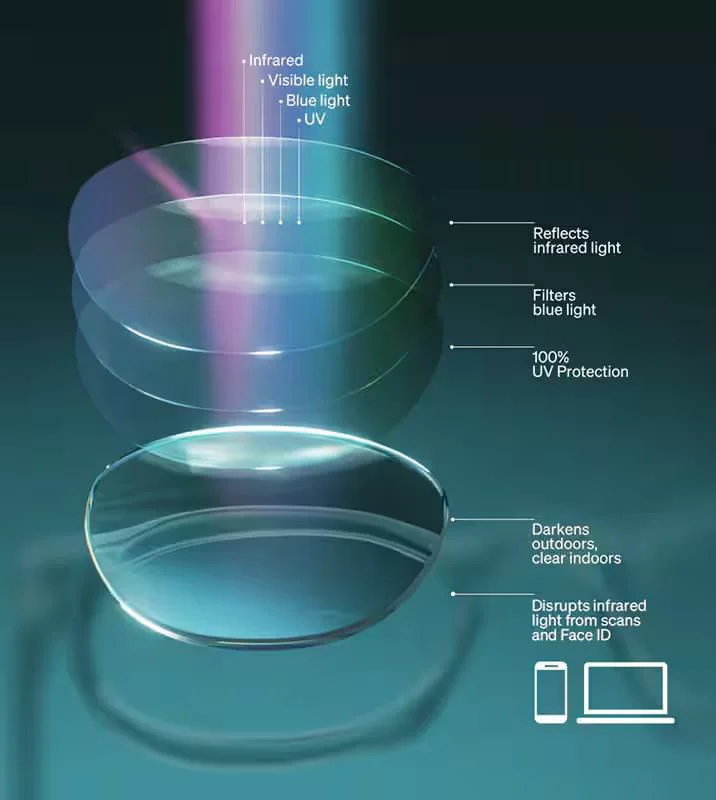
A multilayer coating uses several materials or repeated layers.
For example:
Substrate → Layer 1 → Layer 2 → Layer 3 → Layer 4
Each layer can have a specific refractive index and thickness.
This gives engineers much greater control over the final optical response.
Multilayer structures can be designed for:
- Broad wavelength ranges
- Narrow wavelength bands
- Low reflection
- High reflection
- Spectral filtering
Major Types of Optical Coatings
Anti-Reflective Coatings
Anti-reflective coatings reduce unwanted surface reflection.
They’re widely used on:
- Camera lenses
- Optical windows
- Eyeglass lenses
- Sensors
- Laser optics
- Display components
Reducing reflection can improve transmission and image quality.
High-Reflective Coatings
Some applications require the opposite effect.
High-reflective coatings are designed to maximize reflection over a selected wavelength range.
They can be used in:
- Mirrors
- Laser systems
- Optical instruments
- Beam steering systems
Optical Filter Coatings
Filter coatings selectively transmit or reflect particular wavelength ranges.
This allows optical systems to control which portions of the spectrum reach a detector or sensor.
Potential applications include:
- Camera modules
- Imaging systems
- Sensors
- Scientific instruments
- Industrial optical equipment
Optical Coating Technology for UV and IR Applications
Different wavelength ranges require different coating designs.
UV Coatings
Ultraviolet applications can involve wavelengths shorter than visible light.
Coatings can be designed to provide specific transmission, reflection, or protective characteristics in the UV range.
IR Coatings
Infrared systems operate beyond the visible spectrum.
IR coatings may be designed to:
- Transmit infrared wavelengths
- Reflect selected IR bands
- Block unwanted spectral regions
For camera and sensor systems, accurate spectral control can be critical.
Sapphire as an Optical Coating Substrate
Sapphire is an attractive substrate for demanding optical applications because of its combination of:
- High hardness
- Optical transparency
- Chemical stability
- Thermal stability
- Mechanical durability
It can be used for:
- Optical windows
- Sensor covers
- Protective windows
- Camera components
- Industrial viewing windows
However, the surface may still require additional functionality depending on the application.
SRNC’s Sapphire Super Hard Coating is designed for sapphire applications where advanced surface protection and high-performance coating are required.
The coating system can be engineered around the specific mechanical and optical requirements of the component.
Optical Coating Technology and Surface Protection
Optical performance is only one side of the equation.
An optical component may also need to withstand:
- Scratches
- Abrasion
- Cleaning
- Finger contact
- Chemicals
- Temperature variation
- Humidity
For this reason, modern optical coating systems can be designed to combine optical and protective functions.
A multilayer structure might include:
Adhesion layer → optical layers → hard protective layer → functional top layer
The actual structure depends on the application.
Deposition Technologies Used for Optical Coatings
Several deposition methods can be used to manufacture optical thin films.
Physical Vapor Deposition
PVD uses a vacuum environment to deposit thin films.
It includes techniques such as:
- Sputtering
- Evaporation
- Arc deposition
PVD provides precise control over coating composition and thickness.
Magnetron Sputtering
Magnetron sputtering is widely used for optical thin-film production.
It can deposit metals, oxides, nitrides, and other materials.
The process can be optimized for uniformity and multilayer deposition.
Ion-Assisted Deposition
Ion assistance can improve film density and influence adhesion and microstructure.
It can be useful for optical coatings that need strong environmental and mechanical stability.
Optical Coating Technology for Camera Components
Camera systems are particularly sensitive to unwanted reflections.
Internal and external reflections can contribute to:
- Flare
- Ghosting
- Reduced contrast
- Stray light
Optical coatings help engineers control these effects.
Camera components that may use specialized coatings include:
- Lens elements
- Cover glass
- Optical windows
- IR filters
- Sensor covers
For smartphone camera applications, SRNC’s Functional Coating for Cell Phone Camera provides another example of specialized coating technology designed around optical and surface-performance requirements.
Optical Coating Technology and Coating Thickness
Film thickness is one of the most important parameters in optical coating.
A small thickness variation can shift the wavelength at which the coating performs optimally.
This means manufacturers need precise control over:
- Deposition rate
- Layer thickness
- Refractive index
- Substrate position
- Process temperature
For multilayer coatings, thickness control becomes even more important because errors can accumulate across multiple layers.
Optical Coating Quality Control
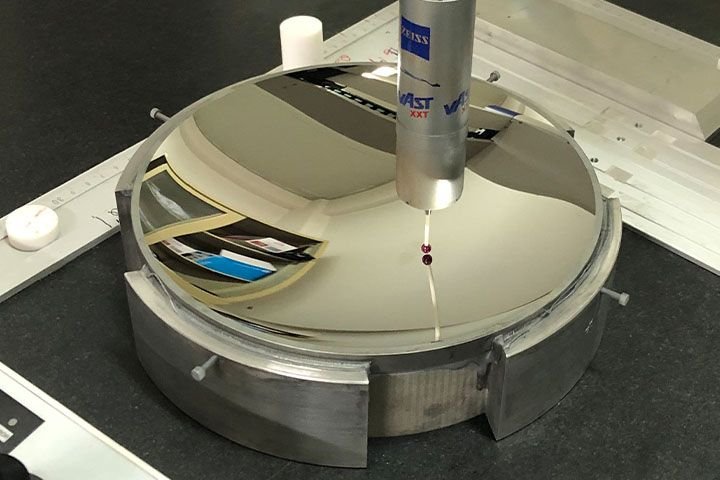
A professional optical coating process requires both optical and mechanical testing.
| Test | Purpose |
|---|---|
| Spectral transmission | Measures transmitted light |
| Reflectance | Evaluates surface reflection |
| Film thickness | Confirms coating structure |
| Adhesion | Checks bonding to substrate |
| Abrasion | Evaluates wear resistance |
| Scratch resistance | Measures surface durability |
| Environmental aging | Tests long-term stability |
| Haze | Evaluates optical clarity |
For precision optical products, testing should cover the wavelength range and angles relevant to actual use.
Factors That Influence Optical Coating Performance
Several variables affect the final coating.
Refractive Index
The refractive index of each layer determines how light interacts with the film.
Film Thickness
Thickness determines interference behavior and therefore strongly affects spectral performance.
Number of Layers
More layers can provide greater design flexibility, although they also increase process complexity.
Deposition Uniformity
The coating needs to remain consistent across the entire component.
Surface Quality
The underlying substrate must have suitable cleanliness, roughness, and optical quality.
Environmental Stability
The coating needs to remain stable under expected temperature, humidity, and chemical conditions.
Optical Coatings for Precision Windows
Optical windows may be used to protect sensors, cameras, lasers, and other optical systems.
The window needs to transmit the desired wavelengths while maintaining mechanical and environmental durability.
Sapphire is especially attractive for applications where the window must withstand harsh conditions.
A suitable coating can then be added to control optical response or provide additional surface protection.
How to Select an Optical Coating
Before selecting an optical coating system, manufacturers should define the application requirements.
Wavelength Range
Specify the relevant UV, visible, or IR wavelengths.
Optical Target
Determine whether the objective is:
- Low reflection
- High reflection
- Filtering
- Spectral transmission
- UV blocking
- IR control
Incident Angle
Optical coating performance can change with angle of incidence.
Substrate
Glass, sapphire, fused silica, and other materials have different optical properties.
Environmental Conditions
Consider:
- Temperature
- Humidity
- Chemical exposure
- Abrasion
- Cleaning
Mechanical Requirements
If the component is frequently handled, scratch and abrasion resistance may be important.
Frequently Asked Questions
What is optical coating technology?
Optical coating technology involves depositing precisely controlled thin films onto optical surfaces to modify how light is transmitted, reflected, absorbed, or filtered.
Why are optical coatings used on sapphire?
Sapphire provides excellent hardness and optical properties, while an optical coating can add specific functions such as anti-reflection, spectral control, or additional surface protection.
What is an anti-reflective coating?
An anti-reflective coating is a thin-film structure designed to reduce unwanted reflection from an optical surface and improve useful light transmission.
What is a multilayer optical coating?
A multilayer optical coating consists of multiple thin-film layers with controlled thicknesses and optical properties. The layers work together to achieve a specific spectral response.
Can optical coatings control UV and IR wavelengths?
Yes. Optical thin-film structures can be designed to transmit, reflect, or block selected UV, visible, and IR wavelength ranges.
Is PVD used for optical coatings?
Yes. PVD processes such as sputtering and evaporation are widely used for depositing optical thin films.
Why is coating thickness important?
Thin-film interference depends strongly on layer thickness. Small thickness variations can change the wavelength and optical performance of the coating.
Can an optical coating also protect a surface?
Yes. A coating system can combine optical functionality with properties such as hardness, abrasion resistance, chemical resistance, and environmental durability.
What substrates can receive optical coatings?
Common substrates include glass, sapphire, fused silica, plastics, and various optical crystals. The coating process must be matched to the substrate.
Conclusion
Optical coating technology provides precise control over how light interacts with a surface.
Through carefully engineered thin films, manufacturers can reduce reflection, increase reflection, control spectral transmission, filter wavelengths, and add protective functionality.
The technology is particularly valuable for sapphire and other precision optical substrates where mechanical durability must work alongside optical performance.
SRNC’s Sapphire Super Hard Coating provides a specialized solution for sapphire components requiring advanced surface protection.
For camera-related optical applications, SRNC’s Functional Coating for Cell Phone Camera offers another application-specific coating solution.
From a simple single-layer film to a complex multilayer optical structure, the success of an optical coating depends on precise material selection, thickness control, deposition conditions, substrate preparation, and application-specific testing.
When these elements are carefully engineered together, optical coating technology can turn a basic optical surface into a highly controlled interface capable of delivering better light management, improved durability, and reliable performance in demanding applications.