

Smartphone Camera Lens: 9 Key Coating Technologies for Better Optical Protection
Today’s smartphone camera looks small on the outside, but there’s a lot going on behind that tiny optical surface.
Modern phones can include multiple cameras for wide-angle, telephoto, macro, depth sensing, and other imaging functions. Each camera module needs carefully engineered optical components to control light and produce clear images.
At the front of the system is the smartphone camera lens.
Depending on the camera architecture, the optical stack may contain multiple lens elements, cover glass, filters, protective windows, and other components. These surfaces need to handle both optical and physical demands.
They must transmit the required wavelengths of light while dealing with fingerprints, oil, water, dust, scratches, and repeated cleaning.
That’s where advanced coating technology becomes important.
A suitable coating doesn’t replace good optical design. Instead, it complements the optical system by giving surfaces additional properties that are difficult to achieve through the substrate alone.
What Is a Smartphone Camera Lens?
A smartphone camera lens is an optical component designed to collect and focus light onto an image sensor.
Modern smartphone camera systems can contain several optical elements arranged together to control:
- Focal length
- Field of view
- Light transmission
- Distortion
- Aberrations
- Image sharpness
The visible surface may also include a protective optical component or cover layer.
Because these surfaces sit in or near the optical path, their properties need to be carefully controlled.
A coating applied to the surface therefore has two jobs:
- Provide the desired functional protection.
- Avoid negatively affecting the optical performance of the system.
Why Smartphone Camera Lenses Need Specialized Coatings
A camera lens has to operate in a surprisingly harsh environment.
During everyday use, it can be exposed to:
- Fingerprints
- Skin oils
- Water droplets
- Dust
- Cleaning cloths
- Cosmetics
- Abrasion
- Temperature changes
A bare optical surface may not provide all the properties required for modern smartphone use.
Coatings can help address these challenges.
Potential coating functions include:
- Anti-reflection
- Scratch resistance
- Water repellency
- Oil repellency
- Anti-fingerprint performance
- Easy cleaning
- Chemical resistance
- Surface protection
9 Important Coating Technologies for Smartphone Camera Lenses
1. Anti-Reflective Coating
Reflection is a major consideration in optical systems.
When light reaches an interface between different materials, part of that light can be reflected.
An anti-reflective thin-film system can be designed to reduce unwanted reflection over a selected wavelength range.
This can help improve light transmission and reduce certain unwanted optical effects.
Multilayer thin films are often used because their optical interference properties can be engineered through layer thickness and refractive index.
2. Hard Protective Coating
Smartphone cameras are frequently handled.
Although the lens itself may be recessed or protected by the camera module, its exposed optical surfaces can still experience mechanical contact and cleaning.
A hard coating can provide additional resistance to:
- Scratches
- Abrasion
- Surface wear
For demanding transparent substrates, specialized solutions such as Sapphire Super Hard Coating can be considered when enhanced surface protection is required.
3. Hydrophobic Coating
Water can interfere with a camera surface in several ways.
A water droplet can remain on the optical surface and change the local optical interface.
A hydrophobic coating modifies the interaction between water and the surface, encouraging water to form droplets rather than spread widely.
This can also make water easier to remove.
4. Oleophobic Coating
Oil is one of the most common contaminants on smartphones.
Skin oils can transfer to the camera surface during handling.
An oleophobic coating is designed to reduce oil adhesion and improve cleanability.
This is especially useful for camera surfaces that are regularly touched or wiped.
5. Anti-Fingerprint Coating
Fingerprints contain both moisture and oily substances.
An anti-fingerprint surface can reduce the visibility and persistence of fingerprint residue.
In practice, anti-fingerprint performance is often related to oleophobic and easy-clean surface characteristics.
6. Easy-Clean Coating
The purpose of an easy-clean coating isn’t necessarily to prevent all contamination.
Instead, it reduces the tendency of contaminants to remain strongly attached.
This means fingerprints, oil, and other residues can often be removed more easily with appropriate cleaning.
7. Chemical-Resistant Coating
Smartphone camera surfaces may encounter:
- Skin products
- Cosmetics
- Cleaning agents
- Oils
- Environmental chemicals
A chemically resistant surface can provide additional protection against these exposures.
The actual resistance depends on the coating chemistry and exposure conditions.
8. Optical Filter Coating
Some smartphone camera systems use optical filters to control specific wavelengths.
Thin-film coatings can be engineered to selectively transmit or reflect parts of the electromagnetic spectrum.
For example, specialized filters can support infrared or ultraviolet control.
This is why optical coating design is an important part of modern camera engineering.
9. Functional Multilayer Coating
Modern camera surfaces often need more than one function.
A multilayer system can combine different properties in one engineered structure.
A simplified example might be:
Optical substrate → Adhesion layer → Optical layer → Hard protective layer → Functional top layer
Each layer can have a specific purpose.
This approach allows the manufacturer to balance optical performance, mechanical durability, and surface functionality.
Smartphone Camera Lens Materials
Smartphone camera optics can use different materials depending on the component and design.
Potential materials include:
- Optical glass
- Optical polymers
- Sapphire
- Other specialized transparent materials
Each material has different characteristics.
| Material | Potential Advantage |
|---|---|
| Optical glass | Optical quality and dimensional stability |
| Polymer optics | Lightweight and suitable for complex designs |
| Sapphire | High hardness and durability |
| Specialized optical materials | Application-specific performance |
The coating process must be matched to the substrate.
Smartphone Camera Lens and Sapphire
Sapphire is particularly interesting for protective optical applications because of its exceptional hardness.
It also offers:
- High optical transparency
- Chemical resistance
- Thermal stability
- Surface durability
These properties make sapphire useful for demanding optical windows and protective components.
However, even a hard substrate may need additional surface functionality.
For example, a sapphire optical component may require:
- Anti-reflection properties
- Water repellency
- Oil repellency
- Easy cleaning
- Specific spectral transmission
This is where an engineered coating system can add value.
How Functional Coatings Work on Smartphone Camera Lenses
A functional coating changes the way the surface interacts with its environment or with light.
For optical functions, the coating controls light through thin-film interference.
For surface functions, the coating can modify:
- Surface energy
- Wettability
- Friction
- Chemical interaction
The final performance depends on coating composition, layer thickness, surface structure, and deposition conditions.
The Role of PVD in Camera Lens Coating
Physical vapor deposition is widely used for precision thin-film applications.
A typical vacuum coating sequence can involve:
- Cleaning the substrate
- Loading components into the chamber
- Creating a vacuum
- Ion or plasma cleaning
- Depositing thin-film materials
- Controlling film thickness
- Applying functional layers
- Inspecting the finished component
PVD allows manufacturers to build very thin, controlled layers without relying on a thick conventional coating.
This is particularly useful for optical components where dimensional changes need to be tightly controlled.
Optical Performance Comes First
A coating on a smartphone camera lens can’t be evaluated only by looking at surface appearance.
The coating also needs to meet the optical requirements of the camera system.
Important parameters can include:
- Visible transmission
- Reflectance
- Haze
- Spectral response
- Uniformity
- Surface quality
Even a very thin film can affect optical behavior.
Therefore, coating design and optical design need to work together.
Durability Requirements for Smartphone Camera Lens Coatings
A coating may look excellent immediately after deposition but still fail prematurely if it isn’t durable enough.
Testing may include:
Scratch Resistance
Evaluates resistance to mechanical damage.
Abrasion Resistance
Simulates repeated rubbing or cleaning.
Adhesion
Determines how strongly the coating remains attached to the substrate.
Chemical Resistance
Tests exposure to relevant chemicals.
Environmental Aging
Evaluates performance after exposure to temperature and humidity.
Optical Stability
Checks whether optical properties remain within specification after durability testing.
Common Problems with Camera Lens Coatings
Reduced Optical Transmission
An unsuitable coating structure can increase unwanted absorption or reflection.
Poor Adhesion
Contamination or inappropriate surface preparation can weaken the coating-substrate interface.
Uneven Appearance
Non-uniform film thickness can cause visual variation.
Surface Contamination
Particles introduced during manufacturing can become defects.
Premature Wear
Repeated cleaning and abrasion can gradually reduce functional surface properties.
Coating Delamination
Mechanical stress, thermal mismatch, or weak adhesion can contribute to film separation.
How to Select a Coating for Smartphone Camera Lens Applications
The best coating depends on the actual use case.
Define the optical requirements
Determine required transmission, reflection, wavelength range, and viewing angle.
Define the environmental exposure
Consider water, oil, dust, chemicals, humidity, and temperature.
Define mechanical requirements
Determine expected scratching, abrasion, and cleaning conditions.
Select the substrate
Glass, polymer, sapphire, and other materials may require different coating approaches.
Select the deposition technology
PVD, sputtering, evaporation, and other processes have different capabilities.
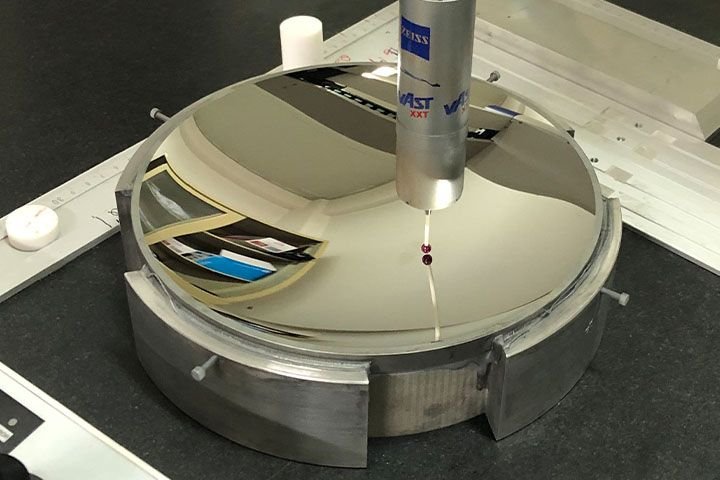
Validate the complete system
The finished coated component should be tested under conditions representative of actual use.
Frequently Asked Questions
What is a smartphone camera lens?
A smartphone camera lens is an optical component or lens assembly that collects and focuses light onto the camera sensor to create an image.
Why does a smartphone camera lens need coating?
Coatings can provide functions such as anti-reflection, scratch resistance, water repellency, oil repellency, easy cleaning, and chemical protection.
What coating is used on smartphone camera lenses?
Depending on the component, coatings can include anti-reflective, hard protective, hydrophobic, oleophobic, optical filter, and other functional thin-film coatings.
Can sapphire be used for smartphone camera optics?
Yes. Sapphire’s high hardness, transparency, and chemical stability make it suitable for certain protective optical applications.
Does coating improve camera image quality?
An appropriately designed optical coating can help control reflection and transmission. However, overall image quality depends on the complete camera optical and imaging system.
What is an anti-reflective coating?
It is a thin-film coating designed to reduce unwanted reflection at an optical surface and improve light transmission over a selected wavelength range.
How does an oleophobic coating help a smartphone camera?
It reduces the tendency of oils to adhere strongly to the optical surface, helping reduce smudges and making the surface easier to clean.
Can smartphone camera lens coatings be multilayered?
Yes. Multilayer structures can combine optical, mechanical, and surface-functional properties within one coating architecture.
How are smartphone camera lens coatings tested?
Testing can include optical transmission, reflectance, haze, adhesion, scratch resistance, abrasion, chemical resistance, and environmental aging.
Conclusion
The modern smartphone camera lens is much more than a piece of transparent material. It’s a precision optical surface that has to perform reliably while being exposed to everyday contamination, handling, cleaning, and environmental conditions.
Functional coatings help bridge that gap.
Anti-reflective layers can manage unwanted reflection. Hard coatings can improve surface protection. Hydrophobic and oleophobic layers can improve water and oil behavior. Optical filter coatings can control selected wavelengths. Multilayer architectures can bring several functions together.
The challenge is getting the balance right.
A successful coating needs to provide its intended surface function while maintaining optical performance, adhesion, uniformity, and durability.
SRNC’s Functional Coating for Cell Phone Camera is designed around the specialized functional coating requirements of smartphone camera components.
For applications using sapphire optical substrates, Sapphire Super Hard Coating offers another route for adding advanced surface protection to a high-hardness transparent material.
For manufacturers developing next-generation mobile imaging components, coating selection should therefore be considered as part of the optical system—not as an afterthought. A well-engineered smartphone camera lens coating can help create a surface that’s clearer, cleaner, more durable, and better suited to everyday use.