

Camera Optical Coating: Precision Thin-Film Technology for Smartphone Imaging
The quality of a smartphone camera isn’t determined by the image sensor alone. Before light reaches the sensor, it must travel through a carefully engineered optical path that can contain multiple lenses, cover glass, filters, and other optical interfaces.
Every one of these surfaces can influence how efficiently light travels through the camera.
Uncontrolled reflection can reduce transmitted light and create unwanted optical effects. Surface contamination and mechanical wear can also affect the long-term performance of exposed components.
This is why camera optical coating has become an important technology in modern mobile imaging.
By applying precisely engineered thin-film layers to optical surfaces, manufacturers can control reflection, improve transmission, and provide additional surface functionality. The coating becomes part of the optical system rather than simply an external protective treatment.
For smartphone manufacturers, this approach helps balance optical performance, component durability, and the demanding size requirements of modern camera modules.
The Optical Path Inside a Smartphone Camera
A smartphone camera is a compact optical system. Although the camera opening may be only a small part of the device, several components can influence the path of incoming light.
Depending on the camera architecture, the optical path may include:
- External camera cover glass
- Multiple lens elements
- Optical filters
- Aperture structures
- Image sensor protection layers
When light passes from one material to another, the interface between those materials can produce reflection.
A single interface may seem insignificant. However, multiple interfaces within a compact camera module can make reflection management increasingly important.
Camera optical coating addresses these interfaces by modifying their optical response through controlled thin-film structures.
What Is Camera Optical Coating?
Camera optical coating is a specialized coating technology developed for optical surfaces used in imaging systems.
The coating is designed according to the optical requirements of the camera rather than simply applied as a general-purpose protective film.
Depending on the application, a coating can be engineered to provide:
- Reduced surface reflection
- Higher light transmission
- Controlled spectral response
- Improved optical consistency
- Surface protection
- Enhanced environmental durability
A coating may contain one or multiple layers. In advanced applications, multilayer structures are commonly used to achieve more precise optical characteristics.
The exact design depends on the camera’s wavelength range, lens material, geometry, incidence angle, and required performance.
Why Reflection Control Matters in Camera Systems
Reflection is one of the key issues that optical engineers need to manage.
When light reaches an uncoated interface, a portion can be reflected rather than transmitted. In a camera system with several optical surfaces, these reflections can interact with the incoming light and create unwanted effects.
Potential consequences include:
- Flare
- Ghost images
- Reduced contrast
- Lower optical efficiency
- Unwanted reflections around bright light sources
A properly designed optical coating can reduce surface reflectance within the target wavelength range.
The purpose isn’t simply to make the lens look clearer. The objective is to improve how the entire optical system handles incoming light.
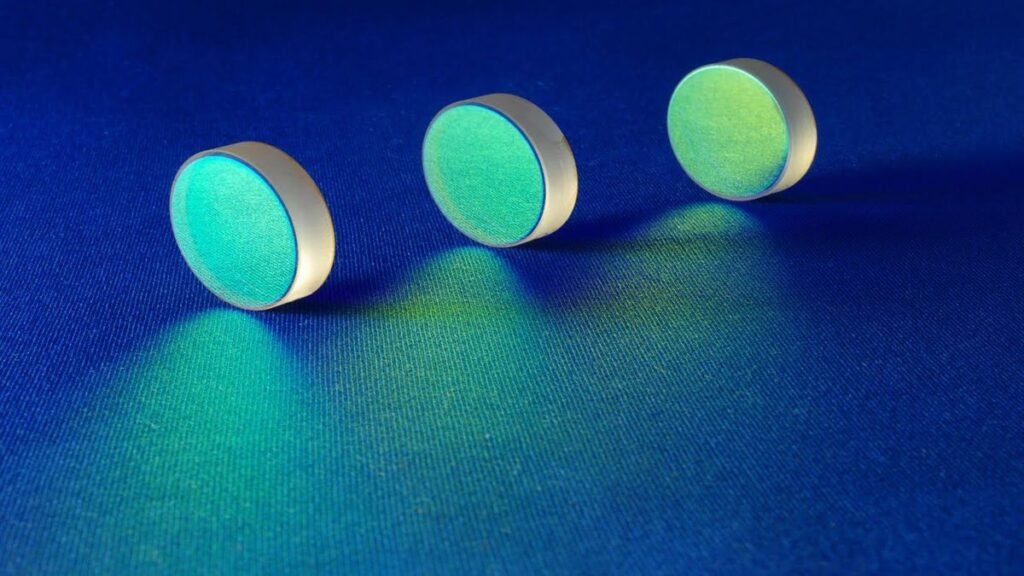
High Transmission and Efficient Light Management
Reflection control is closely connected to transmission.
When less light is reflected at an optical interface, more of the incoming light can continue through the optical path.
This is particularly valuable for smartphone cameras operating in challenging lighting conditions.
A camera optical coating can therefore be engineered to support high transmission over a specified wavelength range.
However, coating design must consider more than maximum transmission at a single wavelength.
A smartphone camera operates across a range of visible wavelengths, and optical performance can also vary with the angle at which light reaches the surface.
This makes broadband and angle-aware coating design an important part of advanced optical engineering.
Camera Cover Glass Requires More Than Optical Clarity
The external cover glass is one of the most exposed components in a smartphone camera.
Unlike an internal lens element, it can come into contact with:
- Dust
- Fingerprints
- Skin oils
- Moisture
- Cleaning materials
- Abrasive particles
As a result, the camera cover glass needs to balance optical performance with surface durability.
A functional coating can be engineered to help address both requirements.
The optical portion of the coating can support transmission and reflection control, while functional surface layers can contribute to protection and environmental resistance.
This multifunctional approach is increasingly useful in premium smartphone camera designs.
Optical Coatings for Different Camera Components
Not every optical component requires the same coating design.
Camera Cover Glass
The cover glass needs to maintain high optical performance while protecting the camera opening from the external environment.
Lens Elements
Individual lens surfaces can be coated to reduce reflection and improve light transmission through the optical stack.
Optical Filters
Filters can use specialized thin-film structures to control selected wavelength ranges.
Camera Module Components
Compact imaging modules may require coating solutions adapted to specific component dimensions, materials, and optical requirements.
This means coating development should begin with the application rather than with a generic coating specification.
Multilayer Thin-Film Structures
Modern camera optical coatings often rely on multilayer structures.
Each layer can have a different refractive index and thickness. When these layers are combined, their optical interactions can be engineered to achieve a desired reflection and transmission profile.
Important design parameters include:
| Parameter | Influence on Coating |
|---|---|
| Layer Thickness | Determines optical interference |
| Refractive Index | Influences reflection behavior |
| Number of Layers | Enables more complex designs |
| Wavelength Range | Defines target optical performance |
| Incidence Angle | Affects optical response |
| Substrate Material | Influences coating compatibility |
This level of control allows manufacturers to create coatings specifically for different camera architectures.
Vacuum Deposition for Camera Optical Coating
The performance of a thin-film coating depends heavily on deposition accuracy.
Modern vacuum coating technologies provide a controlled environment for depositing thin optical layers with high precision.
Depending on the required design, processes can include:
- Magnetron sputtering
- Electron beam evaporation
- Ion-assisted deposition
These technologies can help control film thickness, adhesion, uniformity, and optical properties.
For high-volume smartphone production, process stability is particularly important. A coating must perform consistently from one production batch to another.
Why Uniformity Is Critical for Smartphone Cameras
A camera optical coating can be highly sensitive to variations in film thickness.
Even small process deviations may influence the final optical response.
Uniform coating helps maintain consistency in:
- Transmission
- Reflection
- Color appearance
- Surface quality
- Optical performance
For this reason, coating suppliers need appropriate equipment and quality control systems in addition to coating design expertise.
A successful camera coating solution must work not only on a laboratory sample but also within the realities of mass production.
Functional Coating for Cell Phone Camera
SRNC’s Functional Coating for Cell Phone Camera is developed around the functional requirements of mobile camera components.
The solution can support applications where manufacturers require a combination of:
- Reflection control
- High optical transmission
- Optical surface protection
- Uniform coating performance
- Customized thin-film characteristics
This application-focused approach is important because different camera components can have very different optical and mechanical requirements.
A cover glass, for example, may require stronger surface protection than an internal optical element, while a specialized filter may require tighter spectral control.
Camera Optical Coating and Image Quality
It is important to understand that a coating doesn’t independently determine the image quality of a smartphone camera.
Image quality depends on the complete system, including:
- Lens design
- Sensor characteristics
- Optical alignment
- Aperture
- Image processing
- Coating performance
However, coating quality can influence the optical efficiency and behavior of the surfaces through which light passes.
This is why coating should be considered during optical system development rather than added as an afterthought.
How Manufacturers Should Evaluate an Optical Coating
Selecting a coating requires a clear understanding of the intended application.
Optical Requirements
Define target transmission, reflectance, and wavelength range.
Substrate Compatibility
Check whether the coating adheres properly to the selected glass or optical material.
Environmental Performance
Consider humidity, temperature, abrasion, cleaning, and other real-world conditions.
Coating Uniformity
Evaluate whether the process can maintain consistent performance across the required component area.
Production Scalability
A coating that works in small-scale testing must also be capable of supporting commercial production volumes.
Quality Testing
Optical and mechanical properties should be tested according to the requirements of the camera component.
Camera Optical Coating vs. Standard Protective Coating
These technologies have different priorities.
| Characteristic | Standard Protective Coating | Camera Optical Coating |
| Primary Objective | Surface protection | Optical performance + protection |
| Reflection Control | Usually limited | Major consideration |
| Transmission | Secondary | Critical |
| Spectral Design | Usually limited | Can be customized |
| Optical System Integration | Low | High |
| Thin-Film Engineering | Basic to moderate | Advanced |
For camera applications, a coating must function as part of an optical system.
Future Trends in Camera Optical Coating
Smartphone imaging continues to develop rapidly. Camera modules are becoming more capable while manufacturers continue to reduce their size.
This trend will increase the importance of highly engineered optical surfaces.
Future camera optical coating development is likely to emphasize:
- Higher transmission efficiency
- Wider-band reflection control
- Multifunctional thin-film structures
- Greater scratch and wear resistance
- Better environmental stability
- More precise deposition
- Improved coating uniformity
As camera architectures become more complex, coating design will increasingly need to be integrated with lens and module development from the beginning.
Frequently Asked Questions
What is camera optical coating?
Camera optical coating is a thin-film surface treatment designed specifically for optical components in imaging systems. It can control reflection, improve transmission, and provide additional surface functions.
Why is optical coating important for smartphone cameras?
It helps manage reflection and light transmission across optical surfaces, supporting efficient light transfer through the camera system.
Can camera optical coating reduce reflections?
Yes. Properly designed thin-film structures can significantly reduce surface reflection over a specified wavelength range.
What components can receive camera optical coating?
Applications may include camera cover glass, lens elements, optical filters, and other optical surfaces within a smartphone camera module.
Is camera optical coating the same as AR coating?
Not exactly. Anti-reflective coating is one category of optical coating. Camera optical coating can be designed to provide reflection control together with other optical or protective functions.
Can camera optical coating be customized?
Yes. The coating structure can be designed according to wavelength range, substrate material, transmission requirements, reflectance targets, environmental conditions, and component geometry.
What deposition technologies can be used?
Advanced optical coatings can be produced using technologies such as magnetron sputtering, electron beam evaporation, and ion-assisted deposition, depending on the required coating structure.
Conclusion
The optical surfaces inside a smartphone camera have a direct role in how efficiently the system manages incoming light. Camera optical coating provides manufacturers with a precise way to control reflection, improve transmission, and add functional protection to critical optical components.
The best coating solution isn’t simply the one with the lowest reflectance or highest hardness. It needs to be designed around the complete optical system, including the substrate, wavelength range, incidence angle, lens architecture, environmental requirements, and manufacturing process.
SRNC’s Functional Coating for Cell Phone Camera provides customized functional coating technology for mobile camera applications, helping manufacturers develop optical surfaces with controlled reflection, high transmission, and reliable surface performance.
With precision vacuum deposition and application-focused thin-film engineering, SRNC supports the continued development of smaller, more capable, and higher-performance smartphone camera systems.