

Hard Coating for Smartphone: Engineering Durable Surfaces for Modern Mobile Devices
What Is Hard Coating for Smartphones?
A hard coating for smartphone is an engineered surface layer designed to improve the durability of mobile device components against mechanical contact, scratching, abrasion, and other forms of surface damage.
Modern smartphones contain several surfaces with very different technical requirements. The display cover, camera cover, back panel, and metal components may all require different coating strategies.
For this reason, smartphone hard coating should not be viewed as a single universal coating applied across an entire device.
Instead, the coating system should be designed around:
- Substrate material
- Surface geometry
- Mechanical exposure
- Optical requirements
- Appearance
- Chemical exposure
- Environmental conditions
- Required service life
- Manufacturing volume
Advanced vacuum coating and thin-film technologies provide manufacturers with a way to engineer these properties at the surface level while preserving the underlying material.
Why Smartphones Need Hard Coatings
Smartphones are handled constantly.
During normal use, surfaces can encounter:
- Fingertip contact
- Pocket friction
- Contact with tables
- Dust and particles
- Repeated wiping
- Cleaning
- Keys and other objects
- Sweat and skin oils
- Cosmetics
- Temperature changes
- Humidity
These interactions can gradually produce scratches, abrasion, contamination, or changes in surface appearance.
For a premium mobile device, even relatively small surface defects can affect perceived product quality.
A suitable hard coating can provide an additional protective layer that helps the surface maintain its intended characteristics throughout repeated use.
Hardness Is Only One Part of Smartphone Coating Performance
A common misconception is that a hard coating is defined entirely by its hardness value.
In practical smartphone manufacturing, several properties must work together.
These include:
Hardness
Higher surface hardness can improve resistance to deformation and certain types of scratching.
Abrasion Resistance
The coating should withstand repeated rubbing and mechanical contact.
Adhesion
The film must remain securely attached to the substrate.
Environmental Stability
The coating should maintain performance under relevant temperature and humidity conditions.
Chemical Resistance
The surface may encounter sweat, oils, cosmetics, and cleaning agents.
Optical Performance
For transparent components, the coating must not introduce unacceptable optical losses.
Appearance
For visible surfaces, gloss, color, texture, and uniformity may be important.
A smartphone coating therefore needs to be engineered as a complete surface system rather than optimized for hardness alone.
Different Smartphone Components Need Different Coatings
One of the most important considerations is that a smartphone contains multiple surface types.
Display Cover Glass
The front cover is exposed to frequent touching, wiping, and contact with external objects.
Its coating may need to provide:
- Scratch resistance
- Abrasion resistance
- High optical clarity
- Good adhesion
- Chemical resistance
- Surface uniformity
Because the display is an optical surface, mechanical protection must be balanced with transmission and visual quality.
Camera Cover Glass
Camera surfaces are even more sensitive to optical changes.
A coating may need to provide surface protection while maintaining the optical properties required by the camera system.
SRNC’s Functional Coating for Cell Phone Camera is relevant to this type of application.
Smartphone Back Panel
The back panel often has stronger decorative requirements.
Depending on the design, manufacturers may seek:
- Scratch resistance
- Abrasion resistance
- Controlled texture
- Matte or glossy appearance
- Metallic effects
- Consistent color
- Chemical resistance
Hard coating and texture engineering may therefore be combined to create both protection and a specific visual or tactile result.
Metal Components
Aluminum and stainless steel components may require surface treatments that balance durability, appearance, corrosion resistance, and manufacturing requirements.
The coating process should be selected according to the substrate and final surface specification.
Hard Coating for Smartphone Cover Glass
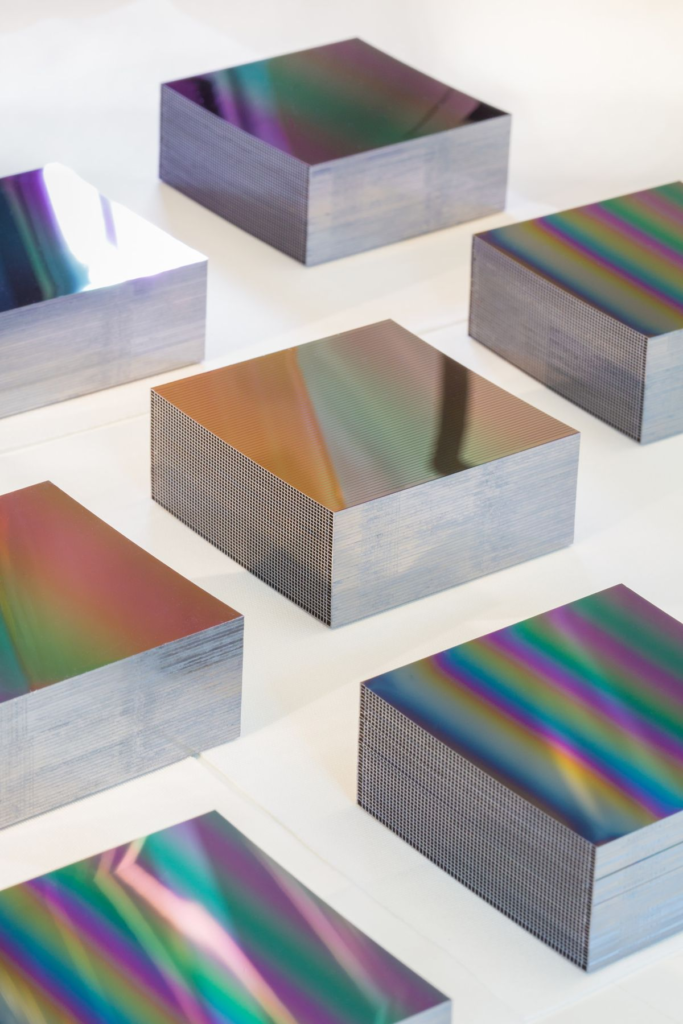
Cover glass is one of the most demanding smartphone surfaces because it needs to remain both durable and optically clear.
A hard coating can help protect the surface from repeated mechanical contact.
However, the coating should be carefully controlled because changes in film thickness or surface condition can influence optical performance.
Important parameters may include:
- Film thickness
- Refractive index
- Surface uniformity
- Light transmission
- Reflection
- Haze
- Scattering
- Adhesion
The coating therefore needs to provide mechanical protection without creating unacceptable visual effects.
Hard Coating for Smartphone Camera Cover Glass
Camera cover glass requires an even more application-specific approach.
The camera system depends on the controlled transmission of light through the optical path.
A poorly designed surface layer could potentially affect:
- Reflection
- Transmission
- Scattering
- Color behavior
- Image contrast
- Surface contamination
At the same time, the camera cover is exposed to scratches, fingerprints, cleaning, and mechanical contact.
This creates a dual requirement:
Protect the optical surface while preserving optical performance.
Advanced thin-film deposition provides a method for carefully controlling coating characteristics.
SRNC’s Functional Coating for Cell Phone Camera focuses on this type of functional camera surface application.
Hard Coating for Smartphone Back Panels
The smartphone back panel provides different engineering challenges.
Unlike the camera cover, the back panel is often strongly associated with product appearance and tactile experience.
A hard coating can help protect:
- Decorative finishes
- Surface textures
- Color effects
- Matte finishes
- Glossy surfaces
- Metallic appearances
Repeated contact can gradually change the visual characteristics of a surface even when the underlying substrate remains structurally intact.
Therefore, coating durability should include both mechanical resistance and appearance retention.
For textured smartphone surfaces, SRNC’s Texture Coating for Cell Phone Back Panel is another relevant surface-engineering solution.
PVD Hard Coating for Smartphones
Physical vapor deposition, or PVD, is one of the technologies that can be used to create advanced hard thin films.
During vacuum deposition, coating materials are deposited onto carefully prepared substrates.
The process can provide controlled thin-film structures with characteristics tailored to the application.
Potential advantages include:
- Controlled film thickness
- Good surface uniformity
- Compatibility with precision components
- Ability to engineer multilayer structures
- Support for decorative and functional surfaces
The exact deposition method depends on substrate material, geometry, coating composition, and required performance.
Surface Preparation Before Smartphone Coating
A high-quality hard coating begins with surface preparation.
Smartphone components may be visually and technically demanding, making contamination control especially important.
A typical manufacturing sequence may involve:
- Incoming material inspection
- Cleaning
- Removal of particles and contaminants
- Surface conditioning
- Loading
- Vacuum treatment
- Coating deposition
- Process inspection
- Final quality inspection
The exact sequence depends on the substrate and coating system.
A clean and properly prepared interface improves the likelihood of stable adhesion and consistent film quality.
Film Thickness and Uniformity
Film thickness is an important parameter for smartphone coatings.
An insufficiently thick film may provide inadequate protection, while excessive thickness can introduce other problems.
Potential concerns include:
- Internal stress
- Optical changes
- Dimensional effects
- Adhesion issues
- Deposition uniformity
Uniformity is particularly important on visible smartphone surfaces.
Variations in film thickness can produce differences in:
- Appearance
- Color
- Optical transmission
- Mechanical protection
- Surface functionality
For this reason, coating equipment, fixture design, component geometry, and process control all contribute to final quality.
Hardness, Scratch Resistance, and Abrasion
These terms are related but should not be treated as identical.
Hardness
Describes resistance to deformation under a specified test method.
Scratch Resistance
Describes the ability of a surface to resist localized damage caused by a harder object.
Abrasion Resistance
Describes resistance to gradual material loss caused by repeated mechanical contact.
A smartphone surface can encounter all three mechanisms during its service life.
A coating specification should therefore consider the actual ways in which the product will be handled and tested.
Chemical Resistance on Smartphone Surfaces
Smartphones frequently come into contact with substances that are not purely mechanical.
Examples include:
- Skin oils
- Sweat
- Cosmetics
- Cleaning solutions
- Household contaminants
These substances can affect certain surface treatments over time.
A hard coating may therefore need to be combined with appropriate chemical resistance.
However, chemical resistance is application-specific. Testing should use the actual substances, concentrations, temperatures, and exposure durations relevant to the product.
Hydrophobic and Oleophobic Surface Functions
Some smartphone surfaces require more than mechanical protection.
Hydrophobic and oleophobic characteristics can help control how water and oily contaminants interact with the surface.
These functions can be useful for reducing the persistence of fingerprints or facilitating cleaning.
However, such surface functionality must be compatible with the underlying hard coating and substrate.
A multifunctional coating system may therefore need to balance:
Hardness + abrasion resistance + optical performance + surface wetting behavior.
This is another reason smartphone coating should be approached as surface engineering rather than simply applying a hard film.
Multilayer Hard Coating Structures
A multilayer structure can provide greater flexibility when several performance characteristics are required.
Different layers may serve different functions.
For example:
- An interface layer can support adhesion.
- A hard layer can provide mechanical protection.
- Intermediate layers can help manage stress.
- Functional surface layers can provide additional characteristics.
The exact architecture depends on the product.
The purpose of multilayer engineering is to achieve a controlled combination of properties rather than simply making the coating thicker.
Testing Hard Coatings for Smartphones
Testing should reflect the actual smartphone application.
Potential evaluations include:
Scratch Testing
Used to assess resistance to localized surface damage.
Abrasion Testing
Used to simulate repeated rubbing and mechanical contact.
Adhesion Testing
Used to determine whether the film remains attached to the substrate.
Hardness Testing
Used to characterize resistance to deformation.
Optical Testing
Important for cover glass and camera components.
Contact Angle Testing
Can help characterize surface wetting behavior for relevant functional coatings.
Environmental Testing
Temperature and humidity testing can help assess stability under controlled conditions.
SRNC’s testing capabilities include film abrasion testing, reflection testing, automatic contact angle testing, cross-cut testing, resistance testing, constant temperature and humidity testing, and salt spray testing.
The final qualification program should be selected according to the smartphone component and customer specification.
Maintaining Performance During Mass Production
Smartphone manufacturing requires high production volumes and tight consistency.
A coating that works on a small sample must also remain stable across large numbers of components.
Production control should address:
- Cleaning consistency
- Loading procedures
- Vacuum conditions
- Deposition parameters
- Film thickness
- Fixture configuration
- Equipment condition
- Inspection procedures
Consistency is especially important for visible surfaces where small variations may become immediately noticeable.
Choosing a Smartphone Hard Coating Supplier
When evaluating a supplier for smartphone hard coating, manufacturers should consider the complete technical capability.
Substrate Experience
Can the supplier process glass, sapphire, metal, ceramic, or other required materials?
Coating Technology
Does the supplier have suitable vacuum deposition and thin-film capabilities?
Testing Capability
Can coating performance be verified using relevant mechanical, optical, and environmental tests?
Customization
Can the coating structure and process be adapted to the component?
Production Capability
Can the supplier move from development samples to stable mass production?
Quality Control
Are process inspection and final inspection integrated into manufacturing?
A supplier should be evaluated on the complete development and manufacturing process rather than on one coating specification.
From Prototype to Smartphone Mass Production
A practical development process can follow several stages.
Step 1: Define the Component
Identify whether the coating is intended for cover glass, camera cover glass, back panel, metal housing, or another component.
Step 2: Define the Performance Requirements
Specify hardness, abrasion resistance, optical characteristics, chemical resistance, appearance, and other requirements.
Step 3: Develop Coating Samples
Establish a suitable film structure and deposition process.
Step 4: Conduct Qualification Testing
Evaluate the coating under relevant mechanical, optical, chemical, and environmental conditions.
Step 5: Optimize Production Parameters
Fine-tune cleaning, deposition, thickness, fixture positioning, and inspection.
Step 6: Validate Pilot Production
Confirm process stability before moving into larger production volumes.
Step 7: Establish Mass Production Controls
Monitor critical process parameters and maintain consistent inspection procedures.
This approach helps reduce the risk of performance differences between development samples and production parts.
Why Smartphone Hard Coating Is Becoming More Advanced
Smartphones continue to combine more functions into increasingly compact components.
A single surface may need to provide:
- Mechanical protection
- Optical performance
- Decorative appearance
- Tactile characteristics
- Chemical resistance
- Environmental durability
- Easy-clean functionality
This makes surface engineering an increasingly important part of smartphone manufacturing.
Advanced thin-film technologies allow manufacturers to modify the surface without changing the fundamental structure of the component.
The result is a coating system designed not just to protect the smartphone, but to contribute to its overall product performance.
Conclusion
A hard coating for smartphone applications must do more than provide a high hardness value.
Different smartphone components—including display cover glass, camera cover glass, back panels, and metal parts—face different mechanical, optical, chemical, and aesthetic requirements.
An effective coating solution therefore depends on careful substrate preparation, appropriate vacuum deposition technology, controlled film thickness, strong adhesion, surface uniformity, and application-specific testing.
For camera components, optical performance is particularly important. For back panels, appearance and texture may become equally significant. Across all components, long-term abrasion and scratch resistance can help preserve surface quality during everyday use.
By combining thin-film engineering with controlled manufacturing and comprehensive testing, manufacturers can develop smartphone surfaces that provide a better balance between durability, appearance, and functional performance.