

Multilayer Optical Coating: Precision Thin-Film Engineering for Smartphone Cameras
Modern smartphone cameras depend on much more than sophisticated image sensors and advanced image processing. Before an image reaches the sensor, light must pass through a carefully engineered optical path containing multiple interfaces.
Each interface can affect how light is transmitted, reflected, or scattered.
This becomes increasingly important as smartphone cameras move toward larger sensors, wider apertures, higher resolutions, and more compact optical modules. Manufacturers need to control optical losses while also protecting sensitive surfaces from everyday wear.
Multilayer optical coating provides a highly precise way to manage these requirements.
Instead of relying on a single film layer, multilayer coating technology combines several ultra-thin layers with carefully selected optical properties. By controlling the thickness and refractive index of each layer, engineers can create a coating structure designed for specific transmission and reflection targets.
For smartphone camera components, this approach makes it possible to combine optical performance with functional surface protection in a very small physical footprint.
Why One Coating Layer Isn’t Always Enough
A single-layer coating can provide useful optical improvement, but modern camera systems often require more precise control than one layer can deliver.
The reason is straightforward: optical performance depends on wavelength, angle of incidence, substrate properties, and the interaction between the coating and the surrounding materials.
A single layer has limited design flexibility.
Adding multiple layers creates additional degrees of freedom. Engineers can adjust:
- Refractive index
- Individual layer thickness
- Number of layers
- Layer sequence
- Target wavelength range
- Reflection and transmission characteristics
This allows the coating to be tailored much more closely to the requirements of a particular optical component.
For high-performance smartphone cameras, that flexibility can be valuable when the available optical space is extremely limited.
What Is a Multilayer Optical Coating?
A multilayer optical coating is a thin-film structure consisting of multiple deposited layers, typically made from materials with different optical properties.
Each layer interacts with the others through optical interference. By controlling the thickness and refractive index of the layers, the overall structure can be designed to increase transmission or reduce reflection within a desired wavelength range.
The coating therefore works as a complete optical system at the surface.
Rather than thinking about each film individually, engineers generally consider the performance of the entire stack.
A multilayer structure can be designed for:
- Anti-reflective performance
- High transmission
- Spectral filtering
- Reflection suppression
- Optical surface protection
- Broadband optical control
The exact configuration depends on the application.
How Multilayer Thin Films Control Reflection
Reflection occurs when light encounters an interface between materials with different refractive indices.
A multilayer structure uses this behavior to its advantage.
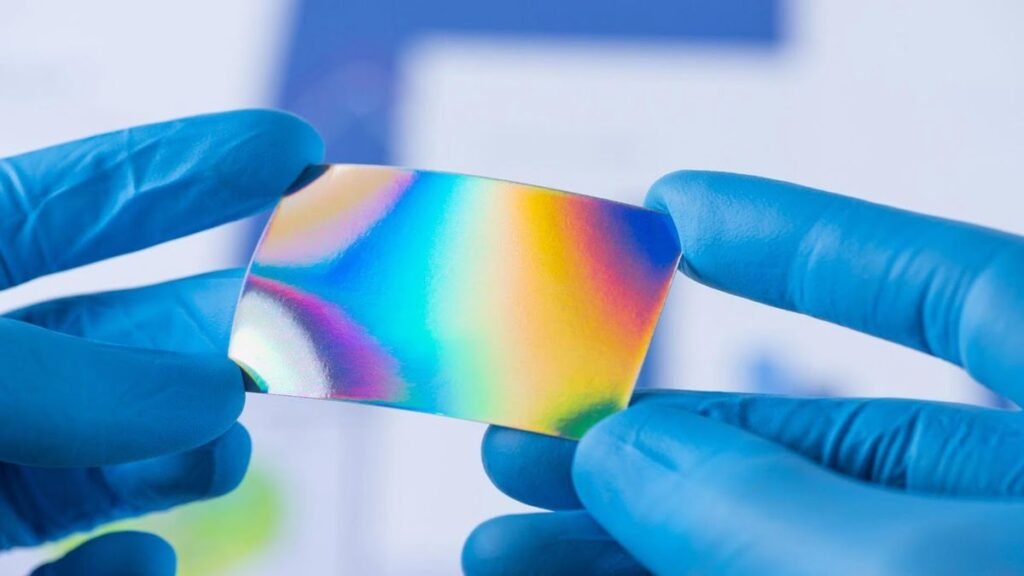
When light reflects from different coating interfaces, the reflected waves can interact with one another. By selecting appropriate layer thicknesses and refractive indices, engineers can encourage destructive interference in the reflected light.
The result can be significantly lower reflectance within the target wavelength range.
At the same time, more light can remain available for transmission through the optical component.
This is one of the fundamental principles behind advanced multilayer optical coating.
The Role of Refractive Index
Refractive index is one of the most important variables in multilayer coating design.
Different coating materials can have different refractive indices. Combining high- and low-index materials creates greater control over how light interacts with each interface.
The coating designer can then optimize the complete stack for the intended optical response.
Important variables include:
| Design Variable | Effect |
|---|---|
| Refractive Index | Controls optical interaction at interfaces |
| Layer Thickness | Determines interference behavior |
| Layer Sequence | Shapes the overall optical response |
| Number of Layers | Provides greater design flexibility |
| Substrate Index | Influences the complete coating system |
| Wavelength | Determines the target performance range |
This is why multilayer optical coating is fundamentally an engineering problem rather than simply a material-selection exercise.
Why Smartphone Cameras Benefit from Multilayer Coatings
Smartphone camera modules operate under demanding optical constraints.
The camera needs to capture sufficient light while controlling unwanted reflections across a compact optical path.
Multilayer coatings can help address several requirements simultaneously.
Higher Light Transmission
By reducing surface reflection, the coating can allow more useful light to pass through the optical component.
Lower Reflectance
Reduced reflection can help minimize unwanted optical effects.
Improved Optical Consistency
A precisely designed coating can provide controlled performance across the required wavelength range.
Functional Surface Protection
Additional layers or coating structures can contribute to improved surface durability.
This combination is especially useful for high-end camera modules where optical performance and component reliability must coexist.
Multilayer Coating for Camera Cover Glass
The camera cover glass is a particularly interesting application.
It forms the external optical window of the camera and therefore has two different responsibilities.
First, it needs to allow light to enter the camera efficiently.
Second, it needs to protect the internal optical components from the outside environment.
The surface can encounter fingerprints, dust, moisture, cleaning, and mechanical abrasion.
A properly engineered multilayer coating can therefore be designed around both optical and functional requirements.
For example, the optical portion may target reflection reduction and transmission, while additional functional characteristics can support surface protection and environmental stability.
Multilayer Optical Coating for Lens Elements
Lens elements inside a camera module have different optical requirements from external cover glass.
The lens system may contain several elements, each contributing to focusing and image formation.
Reflection at these surfaces can reduce optical efficiency and introduce unwanted light paths.
Applying an appropriate multilayer coating to lens elements can help control these reflections.
The coating design may be optimized according to:
- Lens material
- Surface curvature
- Wavelength range
- Angle distribution
- Camera architecture
- Transmission target
This component-specific approach is important because a coating optimized for flat cover glass may not automatically provide the same performance on curved lens surfaces.
Broadband vs. Narrowband Multilayer Coatings
Not every optical coating needs the same wavelength response.
Narrowband Coating
A narrowband design targets a relatively specific wavelength range. This can be useful for specialized optical filters and applications requiring selective spectral control.
Broadband Coating
A broadband structure is designed to maintain useful optical performance across a wider wavelength range.
For smartphone imaging, broadband reflection control can be especially valuable because visible-light cameras operate across a broad portion of the spectrum.
However, wider bandwidth generally creates greater design and manufacturing challenges.
The coating must maintain appropriate performance while accounting for wavelength-dependent behavior.
Angle of Incidence Matters
A coating designed for light arriving straight onto the surface may behave differently when light reaches it at an angle.
This is important in camera optics because lens curvature and module geometry mean that incoming rays don’t necessarily strike every surface at the same angle.
As the incidence angle changes, the effective optical path through the coating layers can change as well.
Therefore, advanced multilayer optical coating design may need to account for angular performance rather than optimizing only for normal incidence.
This is one reason why coating development should be integrated with optical system design.
Vacuum Deposition and Multilayer Coating Manufacturing
Designing a multilayer coating is only half the challenge. The coating also needs to be manufactured with sufficient precision.
Advanced vacuum deposition processes provide the controlled environment required to build thin-film stacks layer by layer.
Depending on the material system and application, processes may include:
- Magnetron sputtering
- Electron beam evaporation
- Ion-assisted deposition
These technologies can provide precise control over film deposition and support the production of uniform multilayer structures.
The manufacturing process needs to control parameters such as deposition rate, layer thickness, substrate condition, and adhesion.
Why Layer Thickness Control Is Critical
Multilayer optical coatings are sensitive to thickness variations.
If a layer is significantly thicker or thinner than intended, the optical response of the complete stack may shift.
This can influence:
- Reflectance
- Transmission
- Spectral response
- Color appearance
- Angular performance
For this reason, coating manufacturers need accurate process monitoring and reliable quality inspection.
In high-volume smartphone production, consistency is just as important as achieving good performance on an individual sample.
Functional Coating for Cell Phone Camera
SRNC’s Functional Coating for Cell Phone Camera is positioned for applications where smartphone camera components require carefully engineered functional surface performance.
Depending on the component and design target, coating technology can be developed around requirements such as:
- High optical transmission
- Reflection control
- Optical surface protection
- Uniform coating performance
- Customized thin-film structures
This is particularly relevant for manufacturers developing camera cover glass, optical lens components, and other precision optical parts.
A customized approach allows coating characteristics to be matched to the actual optical system rather than relying on a generic coating specification.
Multilayer Optical Coating Requires System-Level Design
One of the most important considerations is that coating performance cannot be evaluated independently from the optical component.
A coating that performs well on one substrate may require modification for another.
Likewise, a coating optimized for one wavelength range or incidence angle may not provide the same performance under different conditions.
A complete development process should therefore consider:
- Optical component design
- Substrate properties
- Target wavelength range
- Reflection and transmission requirements
- Angular performance
- Environmental conditions
- Mechanical durability
- Deposition process
- Production volume
- Quality inspection
This system-level approach helps reduce the gap between laboratory performance and real-world camera performance.
How to Evaluate a Multilayer Optical Coating Supplier
For manufacturers sourcing optical coatings, equipment alone isn’t enough.
A capable supplier should be able to connect coating design with production requirements.
Important evaluation criteria include:
Thin-Film Engineering Capability
Can the supplier design multilayer structures for the required optical response?
Deposition Technology
Does the supplier have suitable vacuum deposition equipment for the coating materials and component geometry?
Process Repeatability
Can the same coating performance be maintained across production batches?
Optical Testing
Can transmission and reflectance be accurately measured?
Application Experience
Does the supplier understand smartphone camera and optical component requirements?
Customization
Can the coating be adapted when the camera design, substrate, or performance target changes?
Multilayer Optical Coating and the Future of Smartphone Imaging
Camera systems are becoming increasingly sophisticated without gaining much physical space.
That creates an interesting engineering challenge: more optical functionality must fit into smaller components.
Multilayer thin films are well suited to this trend because they can provide sophisticated optical control without requiring a thick or bulky structure.
Future developments are likely to focus on:
- Wider-band optical performance
- Lower reflection
- Higher transmission
- Better angular stability
- Multifunctional coating systems
- Greater mechanical durability
- More precise mass production
As smartphone camera architectures continue to evolve, multilayer coating technology will remain an important tool for managing the interaction between light and optical surfaces.
Frequently Asked Questions
What is multilayer optical coating?
Multilayer optical coating is a thin-film structure made from multiple layers with carefully controlled optical properties. The layers work together to control reflection, transmission, or spectral response.
Why use multiple layers instead of one optical coating layer?
Multiple layers provide greater design flexibility. Engineers can adjust material properties and layer thicknesses to achieve more precise optical performance.
Can multilayer optical coatings increase light transmission?
Yes. A properly designed multilayer structure can reduce unwanted reflection and increase the amount of light transmitted through an optical component.
Are multilayer coatings used in smartphone cameras?
Yes. They can be applied to camera cover glass, lens elements, optical filters, and other optical components depending on the camera design.
What materials are used in multilayer optical coatings?
Material selection depends on the optical target, substrate, wavelength range, environmental requirements, and deposition process. Different refractive-index materials are often combined to create the required optical response.
Does multilayer coating improve scratch resistance?
It can. Some coating structures can incorporate functional layers designed to improve surface hardness and wear resistance, although optical performance and mechanical protection must be designed together.
How are multilayer optical coatings manufactured?
Advanced vacuum deposition methods such as magnetron sputtering, electron beam evaporation, and ion-assisted deposition can be used to build controlled thin-film structures.
Can multilayer optical coatings be customized?
Yes. Layer structure, thickness, materials, wavelength range, transmission, reflectance, and other characteristics can be developed according to the requirements of a specific optical component.
Conclusion
Multilayer optical coating provides a powerful way to control light at the surface of modern camera components. By combining multiple thin-film layers with carefully selected optical properties, engineers can achieve precise control over reflection, transmission, and spectral behavior.
For smartphone cameras, this technology is particularly valuable because optical components must deliver high performance within extremely compact spaces. The coating therefore needs to work together with the lens design, substrate, camera architecture, and manufacturing process.
SRNC’s Functional Coating for Cell Phone Camera provides an application-oriented solution for manufacturers seeking advanced optical and functional coatings for mobile camera components.
With precision vacuum deposition and customized thin-film engineering, SRNC supports the development of camera cover glass, lens components, and other optical surfaces requiring controlled reflection, high transmission, durability, and consistent production quality.